

vaplp@engageva.org
Program Details
Skill-building Retreats
Movement Leadership
1.
We will lay the groundwork by reflecting on our roles in the social change ecosystem and white supremacy culture, analyzing power dynamics within social movements, and envisioning Virginia's future.
May
Community Organizing
2.
Focusing on relational organizing, we will examine how organizing can create political homes through base-building, leadership development, campaign design, and movement strategy.
June
Narrative + Storytelling
3.
This retreat will begin and end with storytelling about our past and future, with a primary focus on narrative change through framing, messaging, audience analysis, and strategy evaluation.
July
We'll explore how we build resilient organizations diving into components of ideology, structure, strategy, and emotional wellbeing.
Organization + Team Development
4.
August
Workshop Goals
-
Participants will be able to define and explain the Social Change Ecosystem (SCE) and identify their current and future roles within the SCE, as well as utilize the connections and relationships that sustain them to move the work of social change forward.
-
Participants will be able to define white supremacy as a foundational epistemology of the dominant culture and society; identify characteristics of white supremacy at play in our daily lives and practices; and devise strategies and implement practices to combat white supremacy culture in our work.
-
Participants will reflect on different time periods of U.S. history with significant historical impact and analyze what factors led to certain social movements taking off.
-
Participants will identify their values, reflect on the tension between espoused and enacted values, and connect shared values within the organizational and systemic structures we move and work in.
-
Participants will be able to identify imagination deficits in organizational and sector work patterns, and incorporate radical imagination as a process and tool for strategy-building and planning in liberation and social change work.
-
Using the previous workshops and a modified version of the Powell Memorandum, participants will chart a path to transform Virginia from what it is to Virginia as it should be.
Retreat 1: Movement Leadership
-
Reflecting on the work of the ancestors and leaders who have come before us, participants will be able to illustrate and share the torches they carry and legacies they hope to leave behind in their lives and work.
-
Participants will be able to define and identify the components of social change movements and community organizing, and describe their relationships to one another.
-
Participants will be able to identify their constituency and base; and develop and implement a base-building plan to grow, communicate, and mobilize their base(s).
-
Participants will be able to independently and collaboratively devise holistic strategies for deepening engagement and fostering leadership for the members of their organizing base.
-
Participants will take a deep dive into campaign strategy and tactics, including but not limited to the life cycle of a campaign and a window into direct actions.
-
Participants will analyze the opportunities and barriers of different organizing strategies and apply what’s learned to a simulated debate of which organizing strategy is “best” for certain scenarios.
Retreat 2: Community Organizing
-
Participants will share their stories of self, us, & now with each other; and will be able to harness their own stories as tools to advocate.
-
Participants will be reflect on the relationship between culture, cultural organizing, and narrative work; identify dominant and counter narratives in our society.
-
Participants will analyze numerous case studies of narrative campaigns to identify the components of successful narrative strategy.
-
Participants will pull from the Base-Building workshop and practice tailoring to different audiences.
-
Participants will be able to incorporate intentional framing and strategic messaging into their narrative change strategy, utilizing tools like a message box.
-
Participants will identify indicators for narrative success and use the Continuum of Impact to analyze narrative and social impact strategy.
-
Participants will be able to define the different storytelling areas or “themes” within social change work and craft stories within the thematic frameworks that center abundance and liberation rather than pain or trauma.
Retreat 3: Narrative + Storytelling
Retreat 4: Organization + Team Development
-
-
Item description
-
Item description
-
Item description
-
Item description
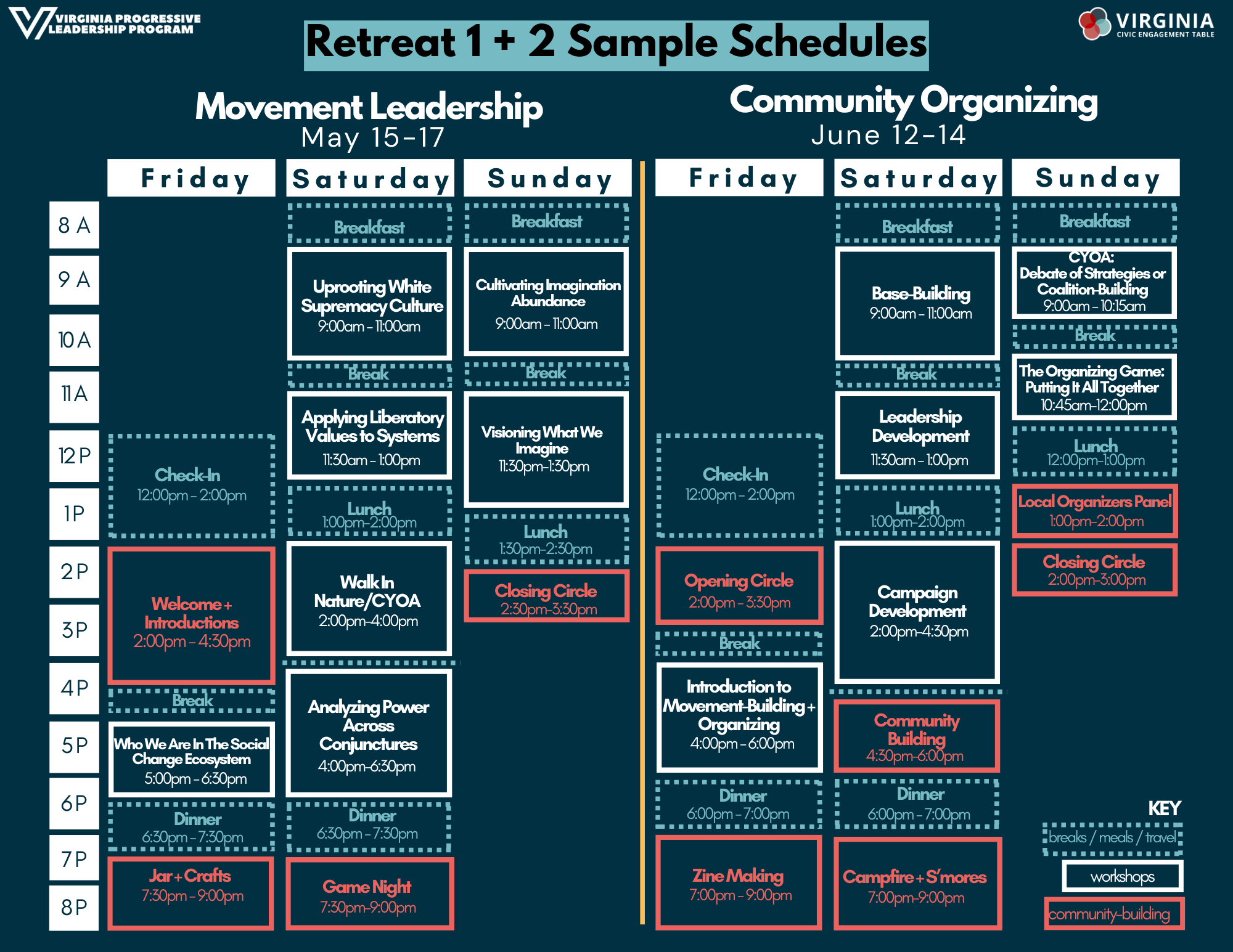
Sample Schedules
Frequently Asked Questions
-
Our program model is guided by a north star of liberatory leadership. As described by the Leadership Learning Community, liberatory leadership is an invitation to leaders to live out the compelling vision of collective liberation through the transformation of ourselves, our communities, and our institutions. Liberatory leadership is rooted in self-love and right-relationship with others and facilitates the power, joy, and thriving of all people.
Strategies for Social Change takes this idea further; liberatory Leadership operationalizes liberatory vision. It draws on numerous personal, organizational, and community practices that invite us to assess, reflect on, unlearn and discard relationships that center power based in supremacy, division and dominance, and invite in models based on equity, community, and self-determination.
Unlike holistic leadership development programs like Rockwood, political and public service leadership programs like Sorensen, or candidate training programs like Meet Our Moment, VAPLP provides training, networks, and resources to drive social movement strategies forward. Through reflection and analysis of the Virginia today and visioning of the Virginia as it should be, participants focus on three core skill-building topics to get there: community organizing, storytelling & narrative, and money & capital.
Our curriculum centers theory and practice from BIPOC movement leaders and organizations.
-
VAPLP prioritizes participants continuous access to a safe, comfortable, and productive environment. An expansive lens of access needs is anything that allows us to show up more fully as ourselves in the space in any given day.
To do that, we have incorporated several ways to increase accessibility, including no-cost attendance, travel stipends, simultaneous Spanish-English language interpretation, all-gender restrooms, mobility access and ADA accessible venues, sensory/quiet rooms, fidget toys, printed participant guides with visual aids, fragrance-free spaces, and more. We aim to ensure accessibility is not a barrier or determining factor for folks to attend.
We don’t assume that we know all access needs or pose this as a comprehensive list of options and needs.
Please reach out to Program Stewards, Nico and Harmony, at vaplp@engageva.org with further questions or accessibility accommodation requests.
-
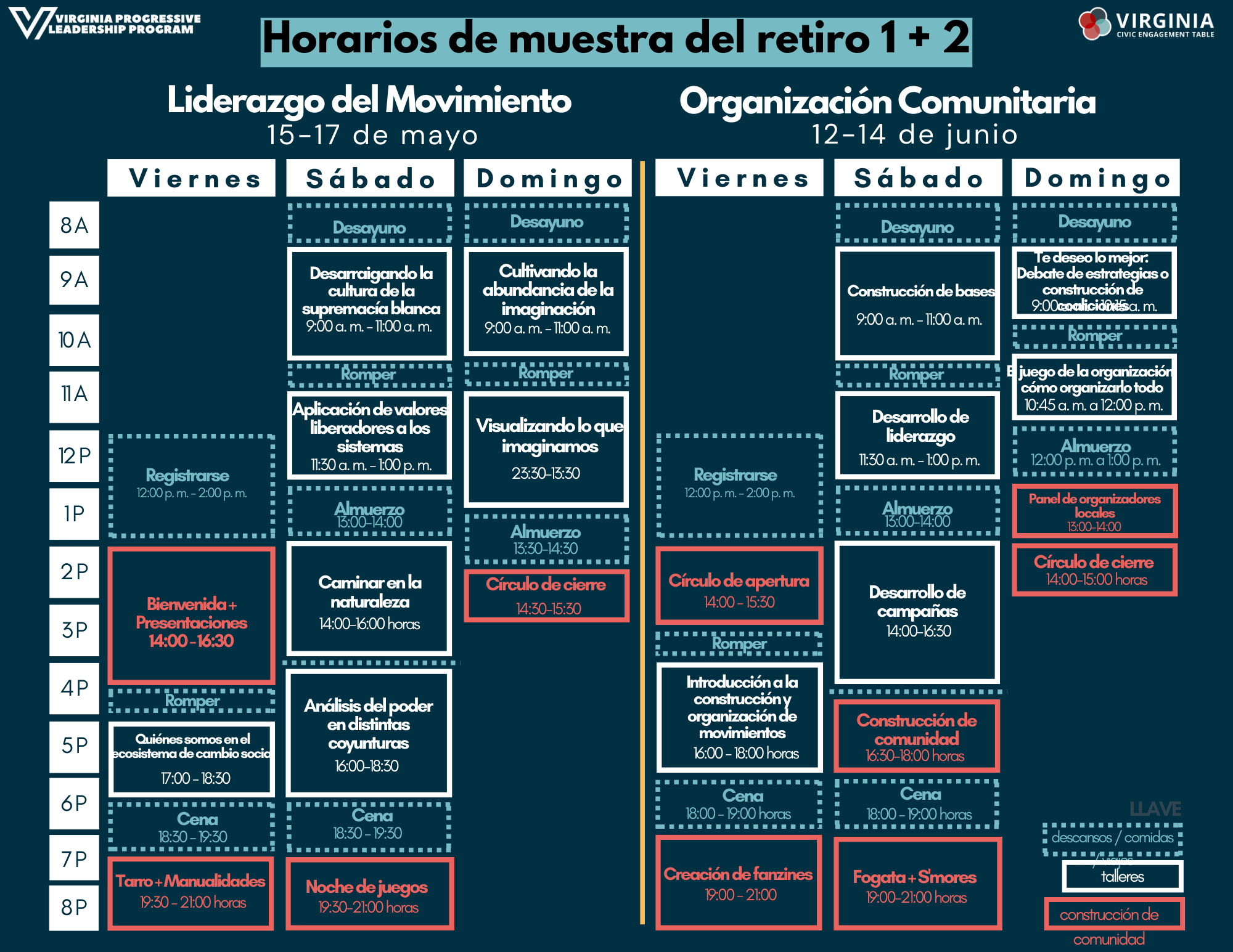
Be prepared for an intensive weekend filled with workshops and community-building. Consistent feedback we receive is that each retreat is jam-packed with content and people time. There’s always an ask for more time to spend together and that it’s equally a lot of time spent together. We hold the tension of both, so we ask that you self-regulate and take time & space to rest when you need to. There are 15-minute breaks in between each workshop and no workshops go past dinner in the evenings. You can get a sense of the schedule in the sample schedules above.
-
There is no cost to attend the program. We cover food and lodging at the skill-building retreats, and offer stipends for eligible participants to cover the cost of travel and childcare.
-
VAPLP is open to any Virginia resident who is actively doing social change work. We prioritize BIPOC folks and those with diverse lived experiences. Our program is for both emerging and seasoned leaders. What we primarily look for is a set of characteristics:
Embracing Diversity: appreciation for and ability to navigate diversity of different voices, identities, and experiences within and between organizations and communities
Collective Action: takes action internally and externally to change the conversations, structures, and paradigms that have been engineered to uphold racial capitalism
Communication + Dialogue: seeks to understand than be understood; leans into generative conflict; open to how different voices can still be harmonious
Community and Solidarity Building: committed to the wellbeing of others; are able to build authentic, safe, and sustainable relationships
Historical, Systems, and Structural Analysis: articulates the connections between the structural and the personal, and between policies and personal identities
Experimentation and Innovation: experiment with new structures, approaches, and resourcing models to create new possibilities; committed to “how we do” as much as “what we do”
Inner Work and Collective Healing: are curious about personal assumptions, narratives, beliefs, values about self and others; recognition to realize racial justice must first start with healing from effects of that trauma
Liberatory Vision + Imagination: invite in ways of being based on equity, community, and self-determination; desire for transformation to discard relationships that center power based in supremacy, division, and dominion
Each pod is multiracial and multigenerational. The demographics typically include folks in age from mid-20s to mid-50s, primarily Black and other folks of the global majority, geographically across Virginia, and primarily women and trans/nonbinary folks. When we select the final participants for the pod, we’re not just considering each individual but we’re looking at the collective pod as a whole.
Characteristics credited to Leadership Learning Community’s “Leadership and Race” 2024 report
-
Each participant will have their own private room with a full size bed or larger, as well as a private bathroom on-site at the retreats. Participants are expected to stay in these accommodations for the whole weekend unless discussed with the Program Stewards in advanced. Each venue is ADA accessible.
-
The Selections Committee is composed of VAPLP alumni and program staff. You can find the members for the Pod 12 Selections Committee here. This team will be reviewing applications, interviewing candidates, and ultimately determining the participants of that pod.
-
Each retreat will have a four-person team, three facilitators and one operations staff, with 2 staff members remaining the same throughout the summer. You can view the facilitation team for Pod 12 here.
-
There are three waivers that you can view here: Participation Agreement, Release and Waiver of Legal Liability, Media Release.
-
The Virginia Progressive Leadership Program (VAPLP) is a collective learning experience built on trust, shared growth, and deep engagement. Each participant contributes to the strength of the cohort, and our time together is designed to honor both your leadership and the leadership of those learning alongside you.
Because of this, participants are expected to attend every retreat weekend and every workshop in full, to the best of their ability. This commitment supports not only your own development, but also the relationships, continuity, and collective learning that make the program transformative.
We ask for this level of participation because:
Our curriculum builds over time. Each session connects to the next, creating a cohesive arc of learning.
Your presence matters. The program depends on the trust and accountability developed within the cohort, and that can only happen through consistent engagement.
We honor everyone’s time and effort. VAPLP invests significant resources to make this program accessible and free of cost, and we structure each weekend intentionally to support participants’ growth.
We understand participants are balancing many responsibilities. We ask that you communicate proactively if conflicts arise and approach this commitment with intention and presence.
Because VAPLP invests significant resources to provide a no-cost, accessible program, participants who leave a retreat early, do not attend a retreat or workshop, or withdraw from the program without consulting with the Program Stewards may be responsible for reimbursing associated costs, such as accommodations or travel stipends, when applicable.
-
You can find a template for a Letter to Your Employer here. Make a copy and download it if you’d like to use it. This can be shared with your employer to make a case for attending the full length of the learning retreats. Upon acceptance, all participants will be required to sign an agreement with their employer to ensure that they will have capacity and approval to attend the learning retreats on-time on Fridays - Sundays. We recommend you starting the conversation with your employer earlier than later.
-
Participants are required to travel to the sites on their own. Participants are eligible to receive a stipend based on distance to sites to cover the cost of travel upon acceptance to the program. The travel stipend will be calculated based on each person’s home address and the federal mileage reimbursement rate. For participants without a vehicle, there will be a carpool signup for any travel during the program days itself. Please note that you’d request carpooling in the application.
-
We offer accessibility stipends, such as travel stipends, and utilize sliding scale tiers that correspond to individual access to money and wealth. Our sliding scale is an intentional effort to distribute resources equitably, with credit to the Anti-Oppression Resource & Training Alliance.
In the application, the questions below make up our “Stipend Self-Assessment”, we do not collect the responses to these questions, but ask you to determine your own level of stipend eligibility.
1. Are you and your family homeowners or landowners?
2. Are your bills or credit cards on autopay?
3. Have you not had difficulty accessing and affording healthcare or health insurance for you or your family members?
4. Do you have zero to no debt and/or do you have disposable income?
5. Do you have a safety net composed of “financially stable” or wealthy family and friends?
6. Do you have U.S. Citizenship?
7. Does your income only support you, and not other loved ones?
8. Have you or do you expect to inherit money or property?
9. Have you (or could you have) attended college?
10. Have you (or could you have) attended graduate school?
Eligibility Level Determination
If you answered “no” to more than five questions → Full Stipend Eligibility
If you answered “yes” to five or more questions → No Stipend Eligibility